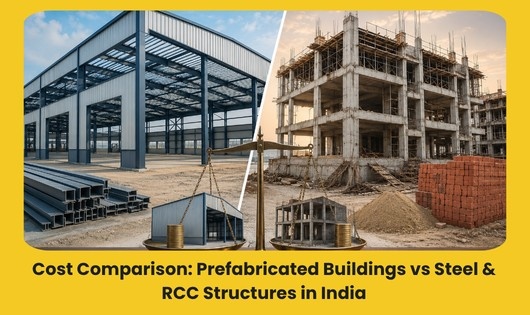
The construction industry of India is experiencing rapid shifts today. You can see infrastructure planners, factory owners and developers preferring faster, more cost-efficient methods. They are comparing regular RCC structures with modern prefab systems, trying to save more money while reducing project timelines as much as possible. Today, prefabricated building model has emerged as a preferred option for the construction of warehouses, factories and many more. Here is a comparison of costs of pre-fabricated buildings vs steel & RCC structures in India.
Initial Construction Cost Comparison
For most developers out there, the upfront expenses are the biggest concern. In India, for low-rise buildings, RCC construction generally appears to be cost effective during the initial stages of planning. However, when speed of construction and project scale are considered, steel and prefab systems often turn out to be more economical.
According to industry reports, the expenses involved with prefab and pre-engineered systems is generally much cheaper than conventional RCC construction for commercial and industrial projects, based on design complexity and location.
In manufacturing units, warehouses and other large-span buildings, the cost advantage is more prominent. Due to faster assembly and reduced foundation loads, overall costs are reduced significantly.
Construction Speed and Labor Savings
Faster completion and time savings are two of the biggest financial advantages of steel and prefab systems. Traditional RCC projects involve shuttering, curing and multiple labour-intensive procedures. These can extend project timelines considerably.
As per studies, around 30–60% construction time can be reduced when steel and prefabricated systems are used instead of RCC structures. This has a direct impact on:
- Labor costs
- Financing and interest burdens
- Site supervision costs, and
- Equipment rental expenses
Faster project delivery means quicker revenue generation and earlier operational use for businesses planning industrial shed or warehouse construction.
By the fourth stage of planning, many developers choose a steel building solution. This is because, unlike conventional RCC method, parallel fabrication and foundation work allow simultaneous progress.
Foundation and Structural Efficiency
As compared to RCC buildings, steel and prefab structures are lighter. As the weight is less, foundation requirements are generally smaller and less expensive.
According to reports from Indian engineering studies, steel structures can reduce around 15 to 25% foundation costs in many industrial and commercial applications. On the other hand, due to greater dead loads, RCC structures need heavier foundations. This increases excavation, reinforcement and concrete usage.
Steel structures also offer more flexibility for modifications and expansions in future. This adaptability is very useful for industrial business owners, who may need to scale up their production units over the long term.
Maintenance and Lifecycle Costs
In the initial stages, RCC construction may appear to be cost-efficient. Over time, however, there can be an increase in maintenance costs due to cracks, seepage and need for repair.
With prefab and steel structures, the benefits generally include:
- Faster maintenance access
- Easier replacement of damaged components
- Better recyclability
- Lower long-term renovation costs
Steel systems can also be salvaged more because it is easier to recycle and reuse structural steel. However, effective corrosion protection and fireproofing measures are needed for steel structures, to make them last longer in harsh environments.
It is easy to understand the various benefits and cost advantages of both types of structures for different types of projects. In case of many traditional projects, RCC continues to be a practical solution. However, steel and prefabricated structures are found to be more economical for all those commercial and industrial projects where efficiency and speed can have a direct impact on profitability. With growing infrastructural demand, modern prefab technologies are expected to play a bigger role in shaping the future of Indian construction sector.