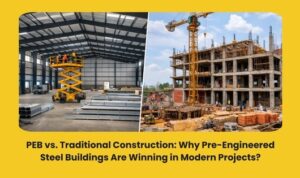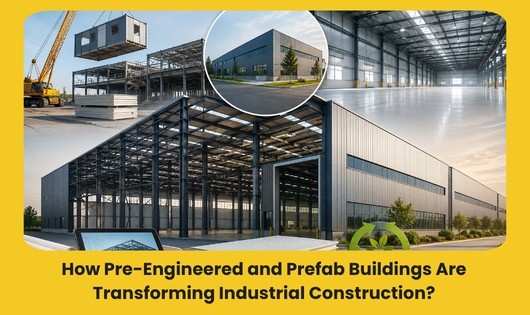
The Industrial construction sector is evolving fast. The adoption of pre-engineered building technologies is one of the most significant drivers in this sector. With rapid industrial growth across sectors like warehousing, manufacturing and logistics, traditional construction methods are struggling to keep pace with the rising demands for cost-efficiency, sustainability and speed. Pre-engineered building systems are setting new standards for industrial facilities across the globe.
Industrial Construction: How Pre-Engineered and Prefab Buildings Are Ensuring Transformation?
Find out how pre-engineered and prefab buildings are transforming industrial construction today.
Accelerated project delivery
Speed is obviously one of the biggest advantages of pre-engineered industrial construction. Site preparation and fabrication can occur side by side, which reduces overall timelines significantly. Many industrial projects can be completed in only a few months rather than requiring around a year for construction.
Due to this benefit, many companies can start operating faster and reduce expenses occurring due to delays.
Cost efficiency and budget predictability
As compared to regular construction methods, it is possible to save a lot of expenses with pre-engineered solutions. Savings occur due to:
- Optimized material usage,
- Reduced labour hours on site, and
- Less waste generated during construction
The design gets finalized before manufacturing starts. It makes project budgets more predictable and can prevent expensive mid-project alterations for many industrial developers.
Superior structural performance
Large, unobstructed internal spaces are often needed in industrial buildings, to accommodate storage racks, machinery and internal movement. Whit pre-engineered designs, it is possible to achieve clear spans of 90 meters or even more without interior columns, which helps to improve functional space significantly.
Steel frames are also used in these projects to make them more resilient against wind loads, seismic activity and heavy industrial use.
Sustainability and reduced environmental impact
Today, there is greater focus on Environmental, Social, and Governance (ESG) goals. Due to this reason, industrial developers are making greener building methods a priority.
Pre-engineered buildings support sustainability in a number of ways. Steel can be recycled significantly. Due to fabrication in factory, there is less on-site wastage. Once buildings are operational insulated panels can improve energy performance. Because of such features, pre-engineered systems are suitable for businesses that focus long-term eco-responsibility.
The Role of Modern Prefabrication
The rise of prefab structure approaches is another complementary trend that is transforming construction today. In this approach, from wall panels to entire units – entire building components are manufactured off-site. Then, these are assembled with minimal need for on-site construction. In industrial settings, prefabrication helps businesses to get more of all those advantages that pre-engineered systems can offer.
Due to prefabricated industrial components, it is possible to complete more of the construction activities in controlled environments. This leads to:
- Faster assembly,
- Less weather-related disruption, and
- Improved quality control
For instance, roof and wall segments can be built to exact specifications in factories. Then, these can be transported and integrated into larger pre-engineered frameworks on-site.
Such a blended strategy, using engineered design with prefab modules, proves to be especially useful for the construction of large-scale warehouse parks, cold storage facilities and manufacturing units that necessitate fast deployment and strict quality requirements. Using such techniques, businesses can find it easier to construct smarter structures and operate them more efficiently. It leads to better cost control, faster timelines, superior quality and of course – sustainability advantages.
It is important to keep in mind that the transformation of industrial construction through pre-engineered and prefabricated approaches is a structural shift, not a temporary trend. As industrial demands evolve, similar evolution can be expected in the technologies that support them. It can safely be said that pre-engineered and prefab solutions will continue to be at the forefront of future construction innovation.