In 2026, the industrial sector of India is evolving very fast. You can see a growing number of logistics parks, smart warehouses, manufacturing clusters and industrial corridors coming up. It is heartening to see more and more businesses seeking faster, more cost-effective and scalable construction solutions. Naturally, PEBs or Pre-Engineered Buildings are experiencing so much demand today.
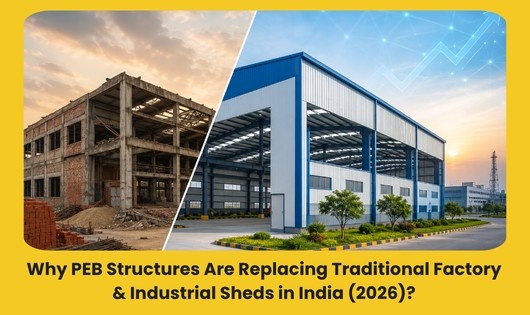
Across India, the PEB structure model is becoming the preferred choice. Many business owners are looking at PEBs as the future of industrial infrastructure. Find out exactly why PEBs are replacing traditional factory & industrial sheds in India in 2026.
Highly time-efficient structures
When it comes to traditional construction methods, business owners often had to encounter problems like:
- Long project timelines,
- Higher labour dependency, and
- Material wastage
Pre-engineered steel buildings are different. Manufactured in controlled factory environments, these are assembled on-site. Due to this reason, there is significant reduction in construction time, more precision and better structural quality. Some recent industry reports indicate that construction timelines can be reduced by 50–75% in case of PEB projects as compared to conventional RCC buildings.
Flexibility and scalability
Modern industries also value flexibility and scalability. Pre-engineered systems, unlike traditional buildings, can be expanded or modified with no major disruption to the overall structure. It is particularly useful for business owners who plan phased growth.
As per operational needs, manufacturers can:
- Increase production capacity,
- Add storage space, or
- Modify layouts
Due to such adaptability, PEBs are highly suitable for factories, cold storage facilities, aviation hangars and logistics centres.
Cost-efficiency
It is another major reason behind this shift. Many Indian industrial developers have to optimize capital expenditure while expanding operations quickly. They find it costlier to go for conventional construction methods due to rising cement prices, labour shortages and fluctuating raw material costs.
Naturally, many companies are opting for steel-based pre-engineered solutions instead of the traditional industrial shed concept. These solutions help to reduce overall project costs and promise faster return on investment. As per industry estimates, as much as 20 to 40% can be saved through optimized steel usage, reduced labour and quicker project completion.
The demand for PEB systems has also been accelerated due to the rapid growth of warehousing and e-commerce. In modern logistics hubs, large clear-span spaces are needed without internal columns. It is possible to get these efficiently with steel-engineered buildings. As PEBs support operational flexibility and future expansion, many companies operating in manufacturing, automotive, pharmaceuticals, textiles and food processing are increasingly choosing these structures.
Sustainability
This trend is also getting popular due to the growing demand for sustainability. Environmental concerns and green building practices are becoming central to industrial development in India. When businesses chose the pre-engineered steel building model, they generate less construction waste. This is because components are fabricated with precision before reaching the site.
It is also important to note that steel is highly recyclable. With the help of steel, it is possible to construct eco-friendlier PEB structures than regular brick-and-cement construction. In many industries, insulated roofing and wall systems are now being preferred. These manage to reduce cooling costs, improving energy efficiency.
Support from industrial policies
This transformation is getting further support from Government initiatives such as “Make in India” and industrial corridor developments. The industrial policies of India are also supporting faster infrastructure deployment. In 2026, plug-and-play industrial development models have been introduced by several state governments, to help businesses begin operations quickly.
it is easy to understand why PEBs are replacing traditional factory and industrial sheds in India. In 2026 and beyond, pre-engineered construction is set to replace conventional construction structures. It will become the backbone of modern industrial expansion in India.