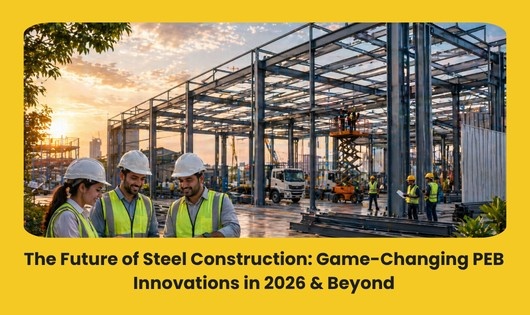
When it comes to steel construction, pre-engineered steel buildings (PEBs) are appearing to be the future. Witnessing faster adoption rates in some of the major sectors of the country, PEB is not just growing. In the recent years, it has begun to emerge as the default standard for industrial infrastructure in India. Moving beyond simple industrial sheds, it is being recognized as a highly digitalized, sustainable and intelligent construction solution. Take a look at some of the outstanding innovations that are positioning PEB as a game-changer, in 2026 and beyond.
Rise of Sustainable PEB Designs
Look around and you will find net-zero energy pre-engineered steel buildings (PEBs) dominating 2026 trends. Coming with recyclable low-carbon steel and solar-integrated rooftops that help to cut down on emissions, these are aligning with the growing push for sustainable structures.
These feature energy-efficient sandwich panels with insulation, such as PUF or Rockwool. Satisfying ESG goals, these are reducing operational costs at the same time. Designs like these can help to minimize waste through precise prefabrication. It makes steel a greener alternative to traditional methods.
AI and BIM Driving Precision
The growing use of artificial intelligence is bringing about major shifts in designing today. AI optimizes PEB design. Cutting-edge AI tools are replacing manual operations. These are being used to handle load calculations, seismic analysis and cost estimates with minimal errors.
3D replicas are now possible with the aid of Building Information Modelling (BIM). These aid in clash detection and collaboration, minimizing the wastage of time and efforts in on-site rework.
CNC cutting and Robotic welding are also being implemented. These ensure dimensional accuracy, faster assembly and safety compliance in fabrication.
Modular and Tubular Construction Speed
In PEB design, tubular steel structures ensure superior load distribution and lighter weight. It helps to reduce foundation costs for factories and warehouses.
Modular PEB components enable 40-60% faster builds via plug-and-play panels and automation. Such a shift is proving to be highly beneficial in addressing a long-standing problem in the industry – shortage of labour. As compared to regular methods, projects can be completed in half the time. It cuts down on manpower requirement, costs and construction time.
Smart IoT-Enabled Buildings
As per Industry 4.0 standards, IoT sensors are being integrated in PEBs. These are necessary for:
- Real-time structural monitoring,
- Predictive maintenance, and
- Energy dashboards
Smart systems are automating ventilation, lighting and HVAC, boosting efficiency in EV plants and logistics parks. All these features and providing pharma facilities and data centres with added support, minimizing downtime.
Resilience and Expansion Features
In 2026, PEBs are being constructed in a special manner. Now available in wind-resistant designs and having advanced coatings, these are able to withstand cyclones, seismic events and corrosion like never before.
Expansion modules allow easy bay additions or crane upgrades for scalable industries. Even in harsh regions with adverse weather conditions, PEBs can last longer due to hot-rolled steel and other high-performance materials used in construction. Innovations such as these position PEBs as the future of steel construction, ensuring sustainability, durability and cost savings in a major way.
Expanding Applications Across Sectors
The versatility of pre-engineered steel buildings (PEBs) is one of the top reasons why these are so much in demand for the construction of e-commerce logistics facilities, cold storage facilities and airport hangars. It is witnessing growing application across various sectors in India at the moment.
PEBs are the choice for EV manufacturing and tech parks, which benefit from clean-room compatibility and rapid deployment. Even in commercial spaces, these are ideal as aesthetic facades for malls and offices. Blending design with functionality, such types of structures are a natural option, ensuring time and cost savings for businesses.
Globally, PEB has become one of the top choices for resilient, net-zero infrastructure. The future looks even brighter. In the years ahead, you can expect deeper AI-IoT fusion, widespread green steel adoption and the use of lightweight steels with superior strength. Supply chains will get a boost from local manufacturing and digital twins; XR will aid in on-site visualization. In the near future, PEB will be a standard, high-performance construction option. Powered by innovations, the Indian PEB market is expected to grow at a CAGR of over 12% through 2033.