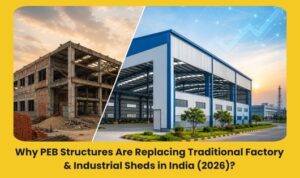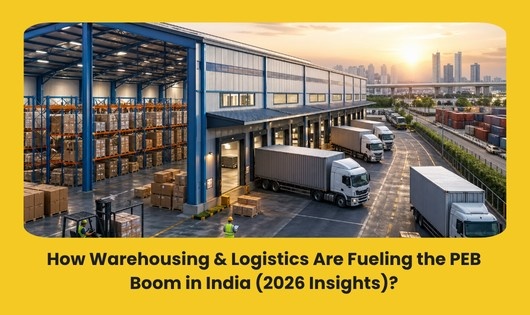
Pre-engineered steel buildings (PEBs) are experiencing a lot of demand in India, for various reasons. Fabricated in factories, these steel structures are designed off-site. On-site, these are bolted together. In 2026, the warehousing and logistics sectors of the nation are witnessing explosive growth. This is having a direct impact on the demand for PEB.
Today, these industries are increasingly opting for PEB, mainly due to its scalability and speed of construction. The demand is being further fuelled by many other factors, such as surges in e-commerce and policy support. Take a look at how warehousing & logistics are fueling the PEB boom in India, with key insights from 2026.
How Warehousing Surge is Driving Demand for PEB?
Pre-Engineered Buildings offer large clear spans that are ideal for warehouses. As compared to traditionally built structures, these can be completed at 30-40% faster speed. Parallel fabrication and erection processes improve construction efficiency. These help to minimize delays that generally result from weather factors and shortage of labour.
In 2024, the warehousing market of India hit USD 58.1 billion. The market is eyeing USD 104.7 billion by 2030 at a 10.3% CAGR. In 2026, the e-commerce sector – said to be worth around USD 163 billion, needs more fulfilment centres and last-mile hubs. This is spurring the growth of Grade A facilities.
In the ecommerce sector, 25% of demand for fulfilment centres comes from the metro regions. There has been record leasing of regional hubs in Q1 of 2026 in the 3PL sector. In the manufacturing industry, production storage facilities have grown in number with accelerated demand for Gati Shakti parks. All these have been some of the major drivers for the growing demand for PEBs.
In the first quarter of 2026, third-party logistics (3PL) and manufacturing absorbed record space. 3PL and e-commerce led leading across the top cities of the country. Due to ecommerce expansion into Tier 2/3 cities, both delivery times and costs are getting reduced. This is boosting the demand for quick-build structures. Pre-engineered steel buildings (PEBs) are proving to be the right solutions for these growing requirements.
How Logistics Growth is Boosting Demand for PEB?
There are various factors at work:
Government Policy Boost for PEB
The National Logistics Policy (NLP) targets single-digit logistics costs from 13-14%. This is leading to a boost in efficiency, through integration and digitization. With initiatives like PM Gati Shakti speeding up the growth of multimodal parks and corridors, fast infrastructural development has become a big priority. PEB warehouses can be constructed in less than 12 months.
Such reforms align with the ‘Make in India’ drive of the Government of India. It is fostering industrial clusters that need scalable storage options.
Strategic Edge of PEBs
The construction of PEB reduces expenses by 20-25%. Construction timeline drops by half due to optimized steel use and minimal wastage.
Scalability allows modular expansions without downtime. It is ideal for evolving logistics parks into smart or cold storage.
It is also worth noting that energy-efficient panels and durability suit sustainable, high-load operations in humid climates. PEBs align with this demand and are seen to be the exact solutions for this surge.
Key Industry Adopters
Many of the top industry players prefer PEB in 2026. PEB is favoured by DHL, Amazon and other major logistics firms for distribution units.
In the manufacturing sector, pre-engineered buildings are growing in number, being used for factory construction. Warehousing is leading PEB adoption in 2026. This year, the warehousing and logistics sectors account for over 57% of all PEB demand by floor area. These are the major drivers for large-span, high-performance and scalable infrastructure.
Market Projections
From $20.05B in 2025 to $21.74B in 2026, the global Pre-Engineered Building (PEB) market has grown at 8.4% CAGR. India is leading this growth through rapid logistics expansion. Investor confidence remains strong, with 56% of investors planning to scale in 2026, focusing on logistics assets.
This year, the logistics sector of India has hit $380B trajectory. PEB has become essential for Tier 2/3 infrastructure. Solid market projections are driving the growth of PEB further.
In 2026, PEBs are leading the way in warehousing and logistics. These are more appropriate for the high-tech, high-speed logistics demands of present times that are set to become the standards in the future. Faster to build, easier to maintain, and promising a lifespan of between 50 and 100 years of well-maintained, these are set to dominate in 2026 as well as in the years to come.