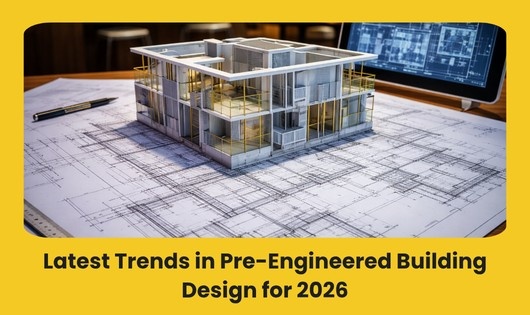
Pre-engineered buildings (PEBs) are getting more popular and evolving faster in design. These are regarded as efficient, adaptable and cost-effective structures. Today, you can find a big change in design trends, which spells better news for the future of these structures. Find out all about some of the latest trends in designing PEBs for 2026.
Use of sustainable principles
Many designers are trying to reduce environmental impact throughout the lifecycle of the buildings. They are choosing:
- Recyclable steel,
- Eco-friendly coatings, and
- Environment-friendly materials that enhance durability
They are also using various passive design concepts, such as:
- Better ventilation planning,
- Improved natural lighting, and
- Strategic solar orientation
They are using these more often. Further, PEBs are also coming with solar panel integration, rainwater harvesting systems and better insulation features.
Advanced digital collaboration and BIM integration
In the designing of PEBs, Building Information Modeling, commonly known as BIM, has become a standard practice. Due to BIM, it is now possible to ensure real-time collaboration between architects, structural engineers, fabrication teams and project managers. This is done through a shared digital model.
AI-based tools are also being integrated into BIM workflows. Designers can minimize errors as much as possible, reducing wastage at every step, and avoiding costly on-site modifications. It helps to save planetary resources at the end of the day.
Modular and hybrid construction techniques
As structural components are fabricated off-site in controlled environments, projects get better. It is now possible to transport and assemble modular PEB parts efficiently, reducing delays caused by weather and labor shortages.
Many designers and architects are also focusing on hybrid construction. You can see PEB steel frameworks being combined with materials such as concrete or engineered wood. Hybrid methods also support multi-purpose buildings. It is easier for industries to expand or redesign their facilities with minimal structural disruption.
Intelligent building systems and IoT integration
With the widespread adoption of IoT-based systems, pre-engineered buildings are now becoming even smarter. You can find sensors and automation being used, to monitor energy consumption, air quality, temperature and occupancy levels.
Due to the use of such systems, there is better efficiency. Lighting, ventilation and cooling can be adjusted automatically, depending on real-time usage patterns. In many areas, predictive maintenance is being used to detect and avoid potential mechanical failures. It helps to reduce downtime, save maintenance costs in the long run and conserve environmental resources more easily.
Aesthetics and customization without compromise
Architects are using innovative facade designs, premium cladding materials and modern glazing systems. These help to make PEB structures visually impressive. Manufacturers are also offering tailored structural solutions while still maintaining speed and cost advantages.
The pre-engineered building industry is now more evolved. Powered by the latest design trends, these are ensuring more value, efficiency and durability, for industries and communities worldwide. It can safely beside that PEBs are the future of construction. In the next few years, these are going to be enhanced with better design features, sustainability and technologically advanced construction practices in countries across the globe.
You May Also Like:
How Much Does a Pre-Engineered Steel Building Cost in 2026?
How Pre-Engineered Steel Buildings Support Faster, Scalable Industrial Expansion
PEB vs. Traditional Construction: Why Pre-Engineered Steel Buildings Are Winning in Modern Projects?