
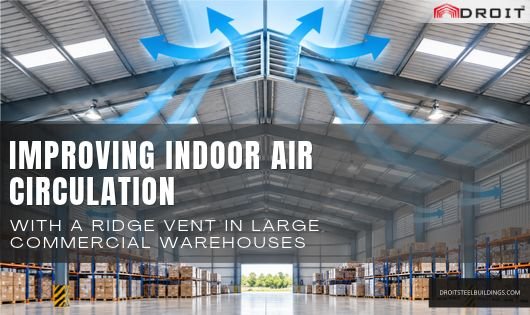
In large commercial warehouses, it is important to maintain proper indoor air circulation. Stagnant air, humidity and heat can affect the comfort and performance of workers as well as the condition of the products that are stored within. A ridge vent can address these problems effectively. This effective roofing solution allows escape of accumulated hot air through the highest point of the roof.
When a ridge vent is designed and set up in a proper way, it can support natural ventilation. It can also improve the indoor environment of a warehouse. Here is how it can improve indoor air circulation in large-sized commercial warehouses.
Choosing and Installing a Well-designed Didge Vent
This is the first step. It is necessary to choose and install a ridge vent. It should match:
- Dimensions,
- Ventilation requirements, and
- Roof design of the warehouse
As warm air rises naturally, it is possible to create a heat outlet near the ceiling with a ridge vent. Engineers have to determine suitable vent size and configuration. They should consider the length, pitch and available ventilation area of the roof.
Offering Enough Intakes for Fresh Air
It is important to ensure the entry of enough replacement air into the warehouse. Otherwise, a ridge vent cannot work efficiently. Due to this reason, fresh air intake openings are included into the design of such buildings.
These may include strategically positioned soffit vents, wall louvers or other ventilation openings based on the structure of the warehouse. As warm air goes out through the ridge vent, cooler outdoor air enters through these lower openings. This encourages constant flow of air.
Removing Accumulated Heat with the Stack Effect
The stack effect is a natural ventilation principle in which warm air rises because it is less dense than cooler air. There can be accumulation of heat from machinery, sunlight, equipment and lighting in large commercial warehouses, just beneath the roof.
With the help of a ridge vent, it can be easy to make this rising warm air escape effectively. Once the heated air goes out, fresh air comes in through lower openings. A natural circulation pattern is established in this way.
Using Ridge Vent with Other Ventilation Systems
It is possible to ensure natural movement of air with the help of ridge vents. However, in some warehouses, it is necessary to install additional ventilation systems to improve indoor air quality and control temperature more effectively. In all such cases, ridge vents can be integrated with:
- Roof ventilators,
- Wall-mounted exhaust fans, or
- Mechanical ventilation systems
Such an approach can be especially useful in facilities with specialised industrial activities, densely stored materials or high heat loads.
Carrying Out Regular Inspections and Maintenance
You can ensure effective performance of ridge vents with regular maintenance. You will be able to identify and quicky fix problems like water infiltration or obstructed airflow due to:
- Dust,
- Damaged flashing,
- Deteriorated seals,
- Debris, or
- Leaves
These can be identified and fixed quickly before they affect ventilation performance or roof durability.
It is necessary to implement all these measures, along with the installation of a ridge vent, to ensure a more comfortable indoor environment in large-sized warehouses. It can help to maintain reliable building performance and ambience at all times of the year.