When it comes to industrial shed construction, it is possible to notice a contemporary approach in pre-engineered buildings. In this approach, building components are designed accurately, fabricated off-site and then quickly assembled on-site. Such components include primary steel frames, secondary support members, roofing and wall cladding. Doors, skylights and various other accessories are included as well. To ensure performance and quality, this process relies on controlled manufacturing and computer-aided design.
PEB solutions shift much of the building process into factory automation. This helps to do away with many of the delays and uncertainties that were part of traditional construction processes. It leads to strong, stable structures, designed to be efficient and adaptable. Take a look at some of the top features of modern industrial and factory shed, using PEB technology.
Insulated configurations
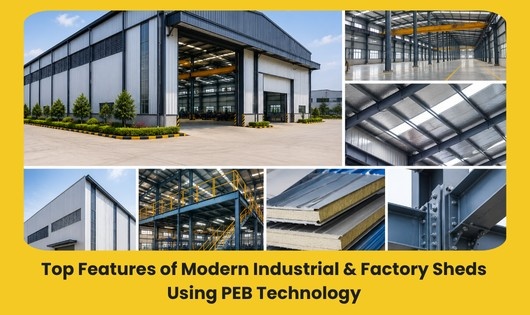
Any industrial building needs to be strong and resilient. High-tensile steel is used for the construction of PEB sheds, to support heavy machinery loads, maintain structural integrity over decades and withstand environmental stresses such as seismic activity or strong winds. As durable steel frames are combined with corrosion-resistant coatings, even under tough conditions, modern industrial sheds continue to be functional.
Roofing and wall panels improve performance further. These are available in single-skin, double-skin or insulated configurations, offering:
- Thermal protection,
- Energy-efficiency, and
- Resistance to weathering
Such features can extend the lifespan of buildings and reduce maintenance requirements.
Custom features, aiding in future expansion
Pre-engineered systems are not one-size-fits-all solutions. Design flexibility is one of the defining strengths of PEB buildings. It is possible to customize each structure to match operational needs, whether that means the inclusion of:
- Mezzanine floors,
- Overhead crane systems,
- Large roll-up doors, or
- Specific interior layouts
Businesses aiming for fast growth can also benefit from the modular nature of PEBs. Buildings like these are inherently suited for expansion. Bays are added to make the buildings longer. Roof height is also modified more easily and at reduced expenses as compared to retrofitting conventional structures.
Cost-efficiency is an important benefit. As PEB systems use optimized steel design, it helps to reduce material waste and labour costs. Less time is involved and there is need for fewer workers on site. With precise fabrication and bulk manufacturing, budget can be controlled tightly throughout the project lifecycle.
Large clear spans, which boost operational efficiency
Wide, uninterrupted floor areas are needed for many industrial operations. These can be used to accommodate manufacturing lines, heavy equipment or warehousing needs.
In this regard, PEB systems excel. These offer up to 90 meters of clear spans, minus internal columns. It can help to maximize usable space as well as simplify workflow and material handling inside the facility.
When PEB technology is used, industrial sheds can be constructed at a much faster speed. Structural components are fabricated simultaneously while site preparation is underway. It can help to reduce overall construction times by as much as 30 to 50% than the time taken for regular construction. Due to faster project delivery, businesses can start operating sooner and get faster returns on investment.
Energy efficient, sustainable features
Across industries, sustainability is a growing priority. Energy consumption is reduced with the help of features like:
- Insulated panels,
- Reflective roofing, and
- Ventilation systems
There is an immediate reduction in cooling and heating expenses due to such additions. Steel can also be recycled easily which makes PEBs more inherently aligned with circular economy principles. It is easy to see how modern industrial and factory sheds built with PEB technology go far beyond the traditional image of a warehouse or workspace. The use of PEB model and the right features help to improve flexibility, efficiency, sustainability and durability, reducing time and costs in a big way.