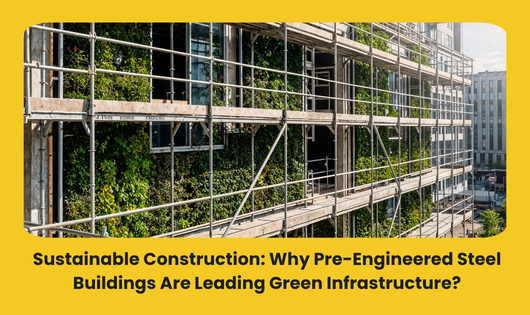
Today, builders are looking for smarter solutions that can reduce environmental impact with no compromise on the quality front. Pre-engineered steel buildings (PEBs) are among the most effective innovations in modern green construction. At a time when cities across the world are expanding, there is naturally a demand for Infrastructure that does not harm the environment in any way. PEBs fit right into this demand. Find out why these are leading green infrastructure at the moment.
Reduced material waste through precision manufacturing
In traditional construction, there is often excessive wastage of materials due to the need for cutting, shaping and modifications on-site. On the other hand, pre-engineered steel buildings are fabricated using exact specifications and computer-aided design.
Before delivery to construction site, each and every component is measured, manufactured and pre-fitted to perfection.
Use of steel
Pre-engineered steel buildings often use recycled steel in the production stage. This lowers the need for mining raw materials and reduces carbon emissions. When a building reaches the end of its life cycle, the steel framework can be dismantled and recycled. Steel does not rust like iron and can be reused in many ways. Even when not directly used in building construction, it can be used for other industrial or manufacturing purposes. It supports a circular economy, proving to be eco-friendly.
At a time when sustainable construction has become the norm, steel, with its recyclable nature, has become a top choice of material for builders around the world. It is one of the top construction materials used in erecting pre-engineered steel buildings that must last and serve for a long time to come.
Faster construction means lower carbon footprint
During construction activities, a lot of fuel and energy is consumed through:
- Transportation,
- Labor operations,
- Use of machinery, and
- Prolonged site activity
While constructing pre-engineered steel buildings, most of the fabrication is finished off-site. This reduces construction timelines significantly.
After delivery, the building can be assembled quickly. There is less need for labor, machines and fuel. Due to reduced site activity, carbon emissions reduce directly. This makes PEBs ideal for companies that want to obtain green certifications, meeting sustainability objectives.
Energy efficiency and better insulation options
Green infrastructure is not about construction only. It is also about how efficiently a building performs during its life span. Pre-engineered steel buildings can be designed with:
- Advanced insulation systems,
- Reflective roofing,
- Ventilation panels, and
- Energy-efficient wall cladding
Less energy consumption helps to reduce operational expenses and ensures fewer greenhouse gas emissions.
Adaptable and durable
Unlike many conventional structures, these are more durable and can adapt easily to future needs. You can find these lasting longer – even in areas with extreme climates and heavy seismic activities. Naturally, these are used for building individual homes as well as commercial and industrial structures.
It is easy to see how pre-engineered steel buildings are leading green infrastructure. At a time when builders across the globe are trying to reduce environmental harm and conserve planetary resources, these structures are getting more popular for all the right reasons.