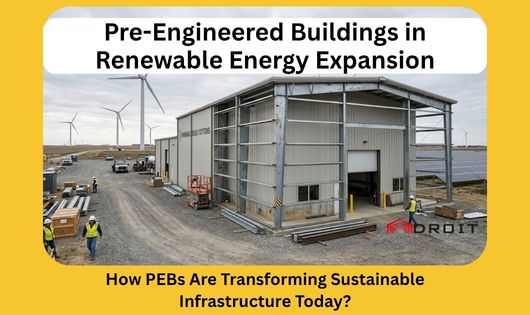
In 2026, you can see the rapid expansion of the renewable energy sector. This is creating demand for infrastructure that can be constructed faster, more affordably and sustainably. Pre-engineered buildings (PEBs) are satisfying this demand in a much better way.
While constructing these types of structures, it is possible to transport and assemble factory-manufactured steel components efficiently. It helps to reduce construction time to as less as around 4 to 6 weeks. Take a close look at why pre-engineered buildings are becoming increasingly important in renewable energy expansion, and transforming sustainable infrastructure today.
Faster Deployment of Renewable Energy Projects
Faster construction is essential while developing renewable energy infrastructure such as:
- Solar farms,
- Wind energy facilities,
- Inverter rooms, and
- Battery storage areas
It can take much longer to build these structures with conventional construction techniques. On the other hand, it takes just 4 to 6 weeks to assemble PEBs. This can speed up project completion much faster. It can also help to make renewable energy facilities begin operations sooner.
The components are manufactured in controlled factory environments first. Then, they are transported to the project site. Due to this reason, rather than prolonged on-site construction, much of the work only involves systematic assembly.
Lower Construction and Foundation Costs
It is important to manage costs carefully while constructing renewable energy projects. This is especially important when developers have to work on large sites. Comparatively lightweight steel structures are used in the construction of PEBs. This can help to reduce the amount of foundation work that is necessary.
By using lighter structures, it is possible to reduce foundation expenses by approximately 5–15%. It can also decrease labor costs by around 20–40%.
Due to these savings, developers are more attracted to PEBs. It can help them to keep construction budgets under control without compromising structural functionality.
Large Clear Spans for Solar and Energy Infrastructure
Often, large, unobstructed spaces are needed for renewable energy facilities. These are necessary for storage, equipment and operational activities. It is possible to get wide clear-span designs of up to 120 meters with PEBs. There is no need for interior columns.
When it comes to building infrastructure for solar projects, this flexibility in design proves to be especially useful. Large open interiors can accommodate:
- Heavy solar equipment,
- Battery storage systems, and
- Other installations
The available floor area can also be used more efficiently. Due to this spacious design, there can be more convenience in movement and equipment placement.
Greater Sustainability
Sustainability is not restricted only to the amount of energy generated by a renewable project. It is equally important to consider the environmental impact of the infrastructure that is necessary to support that energy. Steel PEB components can be recycled up to 98%. It can help to minimize construction-related waste and offer support to circular material use.
PEBs can also reduce embodied carbon by as much as 40–50%. Further, these can help to reduce material wastage. Due to this reason, these are particularly suitable for renewable energy developments where developers are expected to satisfy stricter environmental and green-building objectives today.
Reduced Material Waste and Efficient Manufacturing
Controlled manufacturing process is another important advantage. In the conventional construction process, structural components are produced entirely at the construction site. However, PEB elements are designed and manufactured in factories, as per project requirements. The components are assembled on-site later.
Due to this controlled approach, there is more accurate usage of materials. It can help to reduce unnecessary waste. With PEBs, it is possible to get a construction system that combines prefabrication with efficient on-site assembly. Such kind of efficiency is especially useful in case of large-scale renewable energy expansion, where it is often necessary to develop multiple facilities within tight schedules.
Supporting the Future of Clean Energy
Due to the constant growth of solar, wind, and energy-storage infrastructure, there is a growing demand for fast, economical, adaptable and eco-responsible construction methods. It is possible to get all of these advantages with pre-engineered buildings. Naturally, these are becoming more and more relevant to the renewable energy sector.
It is easy to understand how PEBs can offer practical infrastructure for the next generation of clean energy projects. With reduced labor and foundation costs, faster installation, minimal material waste and large clear-span capabilities, these are rightly being regarded as the way to go forward.