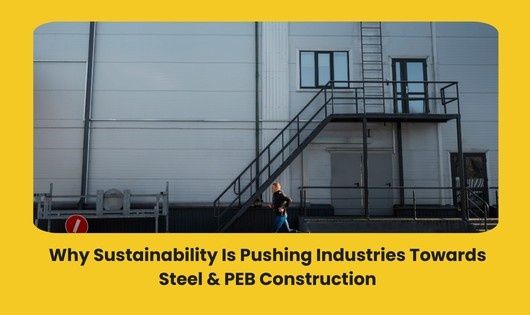
Environmental impact is no longer a side note in industrial construction.
Whether you’re applying for green building approvals or planning long-term efficiency, material choices now sit closer to the center of project decisions.
Steel has seen a major shift in this regard. It aligns with both sustainability goals and business demands.
The result: more industries are moving toward systems that deliver on both fronts, like pre-engineered buildings in India.
Steel reduces resource waste from the ground up
Unlike conventional builds, steel construction avoids excess materials during execution.
Each frame section is manufactured to spec, so there’s minimal cutting, rework, or offcut disposal at the site.
This precision helps reduce construction waste across large projects.
It also avoids overdesign, using only what the structure needs instead of over-reinforcing by default. For businesses aiming for cleaner supply chains, this alone shifts the material equation.
PEB systems are easier to dismantle, reuse, and relocate
Sustainability isn’t only about how a building starts. It’s also about how it ends.
Steel structures make it possible to repurpose entire sections without tearing everything down.
When a facility needs relocation or expansion, many components (rafters, columns, even sheeting) can be reused as is.
This avoids full demolition and reduces the embedded carbon footprint that comes from constant rebuilding.
We’ve supported clients in designing reuse-ready modules from day one.
Operational efficiency improves year-round energy use
Energy use inside a facility depends as much on how it’s built as on what it’s built with.
Steel buildings give you better control over that equation.
Their structural layout makes it easier to integrate practical systems that help moderate heat, light, and airflow without relying entirely on mechanical solutions.
Some of the more effective integrations we’ve seen include:
- Insulated panels that maintain thermal consistency across wall and roof surfaces
- Ridge vents and louvered bays that allow cross ventilation through passive airflow
- Translucent sheeting positioned to extend natural light deeper into the building
These features don’t just support compliance or tick sustainability boxes. They help reduce peak energy loads, improve working comfort, and lower the cost of keeping the space usable year-round.
Material traceability supports ESG and reporting needs
For industries under ESG mandates or global supply audits, material history matters.
Steel offers a clear advantage here. Sourcing, grade, and composition can be tracked throughout the production and build process. This helps procurement and compliance teams document environmental performance without adding overhead.
In projects where certifications or investor disclosures are involved, sustainable steel buildings provide clarity beyond general intent.
Final Thoughts
The shift to sustainable building practices is already underway and steel makes that shift more practical.
Across our projects, we’ve seen how PEB systems support both environmental goals and construction demands without compromise.
We manage detailing, fabrication, and component finishing in-house, which makes it easier to support energy-ready and reuse-capable builds from the start.
If you’re looking for ways to align your next project with long-term sustainability, we’d be glad to talk. Contact us to learn more.