Across India, infrastructure builds are moving faster than before. From transport hubs to cold storage to training centres, public projects now span diverse geographies with tighter schedules and higher expectations.
If you’re part of this system (whether bidding, consulting, or executing), you’ve likely noticed one thing: speed matters more than ever.
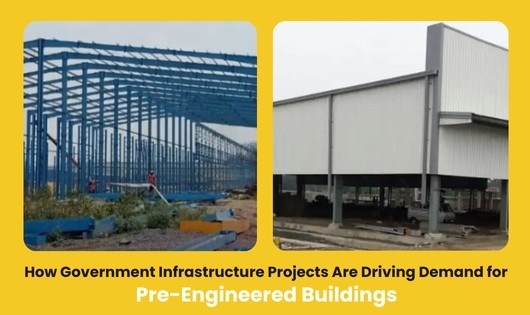
That’s where steel has stepped in. Pre-engineered buildings for government projects are no longer a workaround. They’ve become a serious, scalable solution.
Faster execution keeps the project calendar on track
Government contracts often come with non-negotiable milestones. Steel buildings make it easier to meet them.
Since most structural elements are fabricated before reaching the site, there’s far less dependency on on-site labor or local material supply.
Foundations get done while the frame is being prepped elsewhere.
Once ready, the frame goes up in days (not weeks). This shift helps clients stay within deadlines, especially when commissioning schedules tie into annual plans or budget-linked clearances.
Replicable designs support district-wise rollouts
Many public programs involve the same type of facility repeated across multiple districts. Steel makes this easier.
Once the design for a primary health center, warehouse, or skilling facility is approved, the same structure can be scaled across locations with minor changes. This helps:
- Maintain structural quality across states
- Reduce drafting and consultant costs
- Standardize equipment placement
- Simplify compliance and inspection
- Cut down on procurement delays
When timelines span years but deliveries run monthly, these efficiencies start adding up.
Structures respond better to on-site realities
Even when the project brief stays the same, the site rarely does.
You might need more ventilation in one location, or a higher plinth in another. In some cases, the layout needs to shift slightly to work around local access, utilities, or terrain.
Steel gives more room for that kind of adjustment. The frame can be modified without starting from scratch. That flexibility becomes especially useful when you’re working across multiple regions, with timelines that don’t allow for redesign at every step.
For infrastructure steel buildings in India, this ease of adaptation keeps the build process moving, even when conditions vary from site to site.
Material systems contribute to long-term efficiency
More public projects now come with sustainability requirements. Steel plays a role here without needing extra effort.
Since the components are pre-cut and shaped at the factory, there’s less scrap on site. Fewer trucks carry waste out. Fewer materials go in.
It also works better with other systems. Insulated wall panels fit more tightly. Roof lights and solar mounts install with less trial and error.
Over time, that integration brings real efficiency, not just in terms of energy, but in how the building ages. For projects aiming at certifications or future-ready use, steel tends to support the process rather than slow it down.
Final Thoughts
Pre-engineered steel systems are quietly becoming central to how public infrastructure takes shape in India.
When execution windows are short and delivery pressure is high, they provide clarity in design, in pace, and in performance.
At our end, we work closely with public and private contractors to ensure each structure moves from drawing to delivery without friction.
If you’re exploring steel solutions for government-backed infrastructure projects, and want better control over timelines, materials, and site challenges, reach out to our team. We’ll walk you through how we approach projects built to hold up under pressure.